Biological Cultivation Blueprints
Our Craft Living Soil Facility operates on a fundamental principle: maximize cannabinoid and terpene synthesis by mimicking complex, natural ecosystems.
The No-Till Living Soil System
Unlike standard commercial hydroponics that discard rockwool slabs or coco media after every harvest, our Craft Living Soil Facility reuses our soil indefinitely. This allows us to preserve and strengthen the established microbial web and mycorrhizal fungi networks.
Post-harvest, we leave root masses in place to naturally decompose, providing organic food for soil biology. Instead of turning and disrupting the soil horizons, our cultivators use a broadfork to gently aerate the beds from below, maintaining structural integrity and aeration.
Key Benefits:
- Mycelial NetworkUnbroken
- Root DecompositionOrganic Feed
- Soil HorizonsAerate, No Turn
The Mycorrhizal & Microbial Network
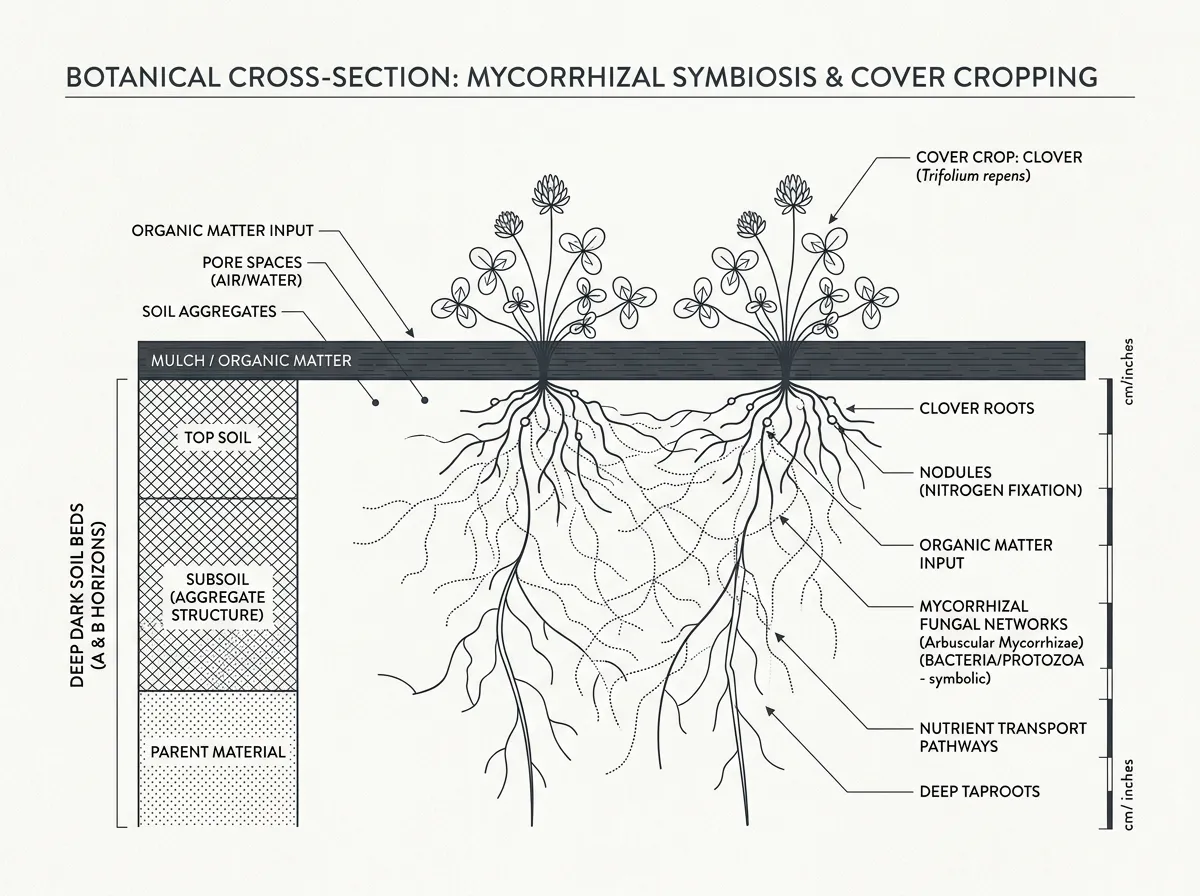
An elegant architectural blueprint of our living soil biology, showing the symbiotic mycorrhizal network that acts as an underground highway, shuttling nutrients and water directly to the plant root zones in exchange for carbon and carbon-based root exudates.
Active Aerated Compost Tea (AACT)
In our Soil Mixing Room, we brew active biology daily inside custom conical tea brewers. Aeration is kept constant to maintain high dissolved oxygen levels, ensuring the tea remains strictly aerobic.
This liquid biology is hand-drenched directly onto our soil beds. We avoid routing the tea through automated drip irrigation lines, preventing biofilm build-up and keeping the dense microbial colonies completely intact.
Brewing Recipe
- Worm Castings2.0% w/v
Rich in native biology - Kelp Meal0.5% w/v
Micronutrients & growth regulators - Blackstrap Molasses0.2% w/v
Bacterial food source - Liquid Fish Hydrolysate0.3% w/v
Fungal food source
Soil Chemistry & Compost Mix
Our proprietary living soil substrate is built with structural and biological inputs designed to maintain proper water holding capacity and air-filled porosity.
The compost and worm castings provide high cation exchange capacity (CEC), locking in nutrient complexes. The pumice provides lasting aeration, and the peat moss retains moisture. Basalt rock dust supplies slow-release paramagnetic minerals. Neem cake and crustacean meal act as organic amendments that slowly release nitrogen and chitin.
Crop Steering & VWC Banding
Unlike inert hydroponic run-to-waste systems, living soil moisture levels must be managed precisely. We keep our volumetric water content (VWC) within a safety band of 45% to 60%. Dropping below 45% risks desiccating the microbial populations, while exceeding 60% leads to root hypoxia.
We execute generative crop steering by allowing 12-15% drybacks between waterings in Weeks 1-5, promoting early flower stack and stack node tightness. In Weeks 6-7, we transition to vegetative steering with tighter 8% drybacks to support swelling and heavy bulk yields.
Biological Integrated Pest Management
Thrive & Grow maintains a strict zero-chemical policy. We do not use synthetic pesticides or fungicides, keeping our flower clean for consumers and protecting our living soil biology.
Instead, we utilize biological agents to combat pests, deploying predatory insects and mites directly into our grow rooms.